Progressive Overload: The Real Reason You’re Not Seeing Results (Yet)
If there’s one thing that separates the guys who actually change their bodies from the ones who stay the same year after year… It’s progressive overload. A lot of people make the gym way more...
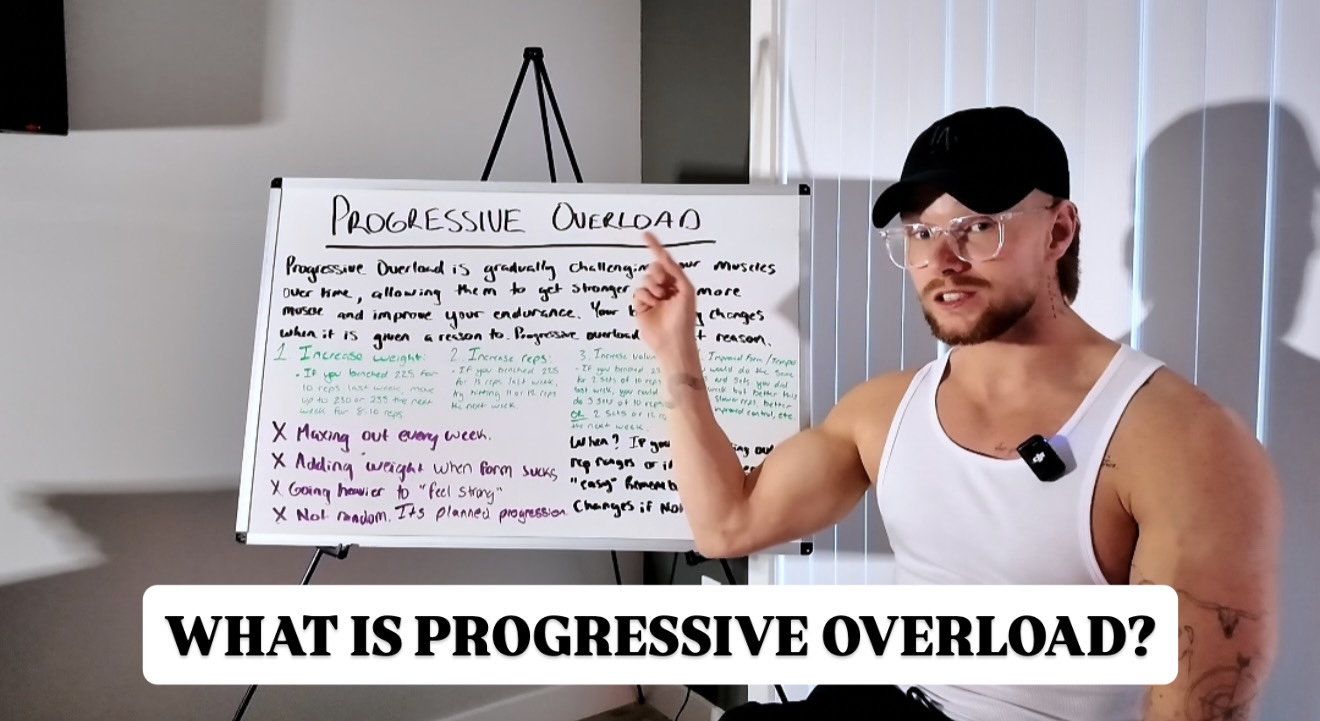
If there’s one thing that separates the guys who actually change their bodies from the ones who stay the same year after year… It’s progressive overload.
A lot of people make the gym way more complicated than it needs to be. Fancy exercises, random workouts they find on TikTok, switching routines every week because they’re bored. Meanwhile, the guys who are getting stronger, leaner, and looking better month after month… they’re all doing one thing consistently:
They’re finding a way to do just a little bit more over time.
That’s literally all progressive overload is.
Not a secret formula.
Not a bodybuilding hack.
Just doing more than you did last week in a smart, structured way.
Let me break this down the same way I explain it to my clients.
1. Adding More Weight (When You Earn It)
This is the one everyone thinks about first.
You lifted 135 lbs last month, now you’re hitting 145 lbs for the same reps… boom, progress.
But here’s the part people skip:
you have to earn the right to add weight.
If your form is breaking down, if the reps look like a full-body seizure, or if you’re shortening the range of motion… that doesn’t count. Adding weight only matters when the quality stays the same (or gets better).
Small, controlled jumps will always beat ego lifting.
2. Adding More Reps
Sometimes the weight stays exactly the same, and that’s fine.
If you hit 8 reps last week and today you hit 10 with the same weight, you still overloaded the muscle.
People underestimate how powerful this is.
Most of my clients progress reps way faster than they progress weight, especially in the beginning. And honestly? It works insanely well.
3. Increasing Total Volume
Volume = sets × reps × weight
You can overload simply by doing more overall work.
That might look like:
- adding an extra set,
- adding a back-off set with lighter weight,
- slowing down your tempo,
- improving range of motion,
- or pushing closer to failure on your working sets.
A lot of guys think they need a “new program” when really they just need more structure and more progression within the one they’re doing.
4. Improving Your Form (The Silent Cheat Code)
This is the part nobody talks about but honestly… it might be the biggest one.
Better form = better tension → better stimulus → better results.
You can keep the weight the same and still overload the muscle just by doing the set with more control, a deeper stretch, cleaner reps, and no swinging or cheating.
My clients hear me say this all the time:
“Perfect form with moderate weight will build more muscle than sloppy form with heavy weight.”
How I Use Progressive Overload With My HupsFit Clients
This is where most people go wrong:
they think progressive overload means “lift heavier every week.”
If that were true, we’d all be benching 600 lbs by now.
Inside HupsFit, we treat progression like a system, not a guessing game.
Here’s how I coach it:
→ We track EVERYTHING that matters.
Reps, weight, sets, form notes… because you can’t improve what you don’t track.
→ We only progress when the quality of the reps is there.
If form falls apart, we fix that first.
Progress doesn’t count unless the movement is actually performed properly.
→ We use small jumps, not giant ones.
The goal is longevity and consistency — not blowing out your shoulder trying to impress your gym crush.
→ Every week we review your workouts in check-ins.
If reps stalled, we choose a different way to progress.
If weight went up but form slipped, we reset and rebuild.
If volume is too high and you’re not recovering, we scale things back.
It’s not random.
It’s not “hope this workout works.”
It’s structured progression that forces results over time.
The Stuff Most People Don’t Realize About Progressive Overload
Let me give you some extra pieces most beginners never hear:
1. Progress won’t happen every session — and that’s normal.
Some weeks you’re tired, stressed, under-eating, whatever.
The trend matters more than the individual workout.
2. Recovery matters more than people want to admit.
You can’t expect to progress if you’re sleeping 5 hours, skipping meals, drinking 3 nights a week, and wondering why the weight feels heavy.
3. Beginners progress faster than advanced lifters.
If you’re brand new? You’ll make huge jumps quickly.
But as you get stronger, things slow down — that doesn’t mean you’re doing anything wrong.
4. Soreness doesn’t equal progression.
You can be sore and make zero progress…
or you can have zero soreness and still be improving every workout.
5. Most guys fail because their training is random.
They walk into the gym, guess their weights, guess their reps, and hope something clicks.
Hope isn’t a strategy.
Progression is.
Final Thoughts
Progressive overload is simple but it requires consistency, patience, and some actual structure.
If you can commit to doing slightly more over time — cleaner reps, more reps, more control, or more weight — your body will have no choice but to change.This is why my clients at HupsFit don’t stay stuck.We don’t rely on motivation.We don’t rely on “good workouts.”We rely on progression — week after week, month after month.
KEEP READING
WHAT IS HIGH TRAINING INTENSITY?
Most guys who struggle to lose fat, build muscle, or see any real change in their body are not failing because of a bad diet. They are not failing because they chose the wrong program. They are...
Read Article →
Best Routine To Lose Fat
The Best Routine to Lose Fat: Fat loss is one of the most misunderstood goals in fitness. Many people believe it requires extreme dieting, excessive cardio, or complex training systems. In...
Read Article →
What Is The Best Way To Workout
The Best Way to Work Out Isn’t Just About the Workout When most people ask, “What’s the best way to work out?” they’re usually asking for a routine. A split. A set and rep scheme. A magic formula...
Read Article →